
Introduction
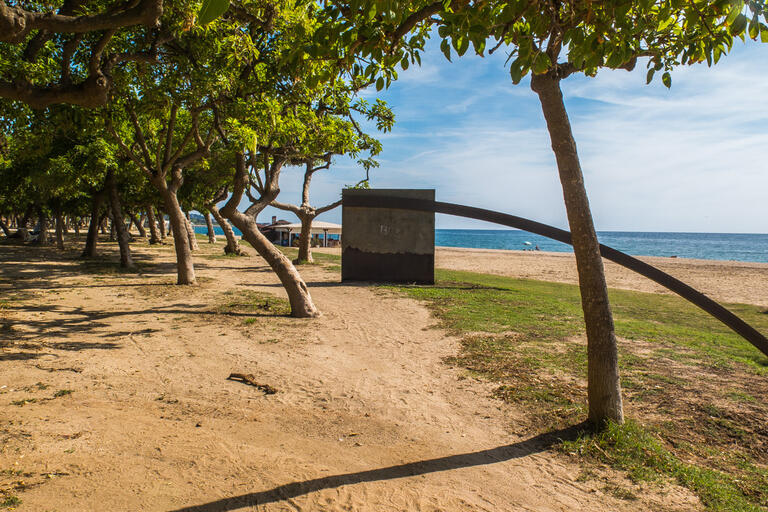
At this point we find a sculpture formed by a large nine-metre arch that rises from the sand and joins a square wall bearing the inscription “El Camí del Nord”, which marks the start of the 213 km route that links the city of Mataró with Prada de Conflent (Northern Catalonia). The lower part of the wall is covered by a plate showing the outline of the Pyrenees and the names of all the villages the route passes through. The sculpture is aligned with the meridian.
The Camí del Nord, also known as the Camí del Canigó and waymarked as the GR83, retraces the path followed by thousands of Republican exiles at the end of the Spanish Civil War, between January and February 1939, as they fled to France via the Coll de Malrem, in extreme human and weather conditions. It is a tribute to all the men, women and children who took it, some of whom lost their lives, and to all the Northern Catalans who helped the exiles.
The GR83 crosses several natural areas: the Montnegre i el Corredor Natural Park, the Montseny Natural Park, Les Guilleries-Savassona, the Garrotxa Volcanic Zone Natural Park and the Canigó massif. The sculpture marks the start of the route.